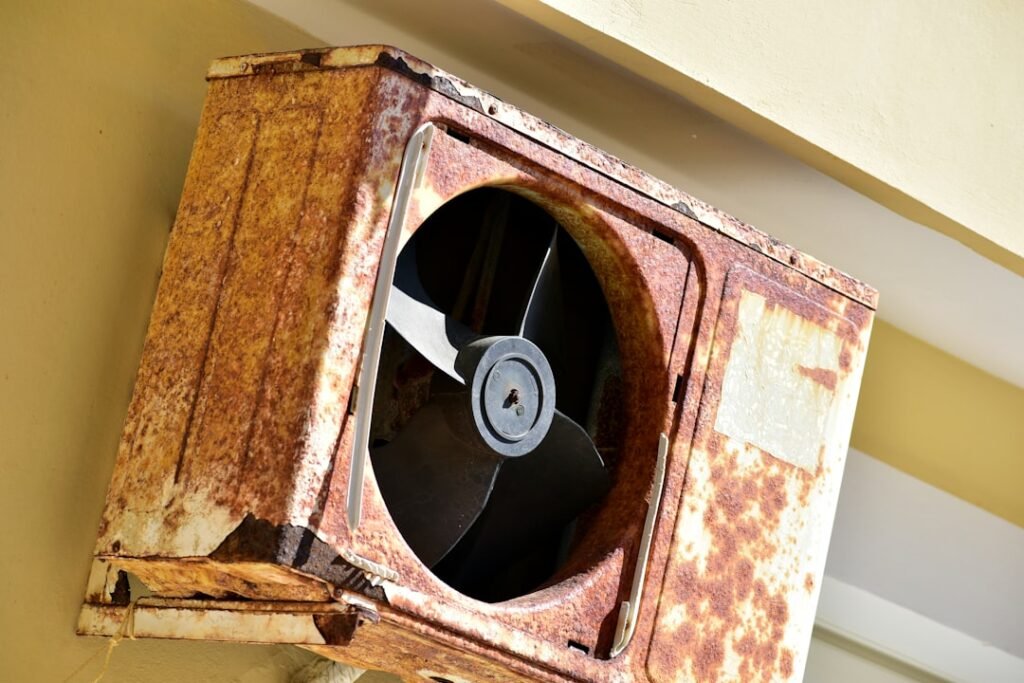
There’s a particular kind of dread that sets in when you flip on your bathroom exhaust fan and hear nothing but a sad, grinding hum — or worse, nothing at all. Ours started going last winter. The motor had given up, the housing was caked with dust, and the whole thing sounded like a box fan duct-taped to the ceiling. My 12-year-old walked in one morning, flipped the switch, listened to the rattling, and looked at me like, “Dad, are we going to fix that?” Yes, son. Yes, we are.
A failing bathroom exhaust fan is more than just an annoyance. In Connecticut homes — where we deal with cold winters, humid summers, and older housing stock that doesn’t always breathe well — a bad exhaust fan means moisture has nowhere to go. That moisture finds walls, ceilings, and grout lines. It feeds mold. It peels paint. It warps wood. I’ve written before about caulking your bathroom to stop leaks before they become disasters, and that’s a great line of defense — but none of that matters much if your ventilation is broken and moisture is still hanging in the air after every shower.
The good news? Replacing a bathroom exhaust fan is a very manageable DIY project. You don’t need to be an electrician. You don’t need to tear out drywall. With the right fan, a few basic tools, and about two to three hours on a Saturday morning, you can have a quiet, efficient, properly vented bathroom fan that will protect your home for years to come. Let me walk you through exactly how we did it.
Why Exhaust Fan Replacement Is Worth Your Time and Money
Bathroom exhaust fans are rated in CFM — cubic feet per minute — which tells you how much air the fan moves. A general rule of thumb is that you need at least 1 CFM per square foot of bathroom space. Most older fans in Connecticut homes are undersized, outdated, and far less efficient than what’s available today. Replacing an old 50 CFM fan with a modern 110 CFM unit can make a dramatic difference in how quickly your bathroom clears after a shower.
Beyond performance, newer fans are dramatically quieter. They’re measured in sones — the lower the sone rating, the quieter the fan. Old fans often run at 3 to 4 sones, which sounds like a small helicopter. Modern fans can run at 0.3 to 1.0 sones. You’ll barely know it’s on. My wife noticed the difference the first morning after we finished the install. She didn’t say anything — she just looked up at the ceiling and smiled. That’s as good as a standing ovation in my house.
From a cost perspective, the U.S. Department of Energy recommends properly sized and functioning bathroom ventilation as a key component of indoor air quality and moisture management. The average quality replacement fan runs $35 to $80 at your local home center. A contractor would charge $150 to $300 to swap one out. This is the kind of job where spending two hours on a Saturday saves real money while teaching your kids that problems have solutions.
Tools and Materials You’ll Need
Before you start, gather everything. There’s nothing worse than being halfway through a job with a wire hanging out of the ceiling and realizing you’re missing something. Here’s what you need:
- Replacement exhaust fan (match the CFM to your bathroom size; look for 1.0 sones or lower)
- Flathead and Phillips screwdrivers
- Non-contact voltage tester (essential for safety — never skip this)
- Needle-nose pliers
- Utility knife
- Flexible foil duct or rigid duct connector (if your existing duct needs replacement)
- Foil HVAC tape (not regular duct tape — it doesn’t hold long-term)
- Wire connectors (wire nuts)
- Ladder
- Work gloves and safety glasses
If you don’t already have a solid set of basic tools, I put together a complete guide to building a DIY starter tool kit from scratch that covers everything a homeowner actually needs. Worth a look if you’re just getting started.
Step 1: Choose the Right Replacement Fan
The easiest replacement is one that fits your existing housing footprint. Many manufacturers — Broan, Panasonic, and Delta are the big three — make fans designed to retrofit into common housing sizes. Measure the opening in your ceiling before you buy. If the new fan is slightly larger, that’s usually fine — you can patch around it. If it’s smaller, you’ll have a gap to deal with.
Look for a fan with these features:
- CFM rating appropriate for your bathroom size (for a standard 8×8 bathroom, 70–80 CFM is fine; for a larger main bathroom, go 110 CFM or higher)
- Sone rating of 1.0 or lower for quiet operation
- Energy Star certification if you want to keep operating costs low
- A built-in humidity sensor is a great upgrade if your budget allows — it turns the fan on automatically when moisture rises and off when the air clears
I had my 15-year-old research fan options on the Broan and Home Depot websites while I assessed the old unit. He found us a solid Energy Star-rated 110 CFM, 0.7 sone fan for $58. That’s a great use of a teenager’s time — practical research with a real-world outcome.
Step 2: Turn Off the Power and Verify It’s Off
Go to your electrical panel and turn off the breaker for the bathroom. Then go back to the bathroom and flip the switch to confirm the fan (and any lights on the same circuit) are off. Then use your non-contact voltage tester before you touch any wires. I say this every time I write about electrical work, because it matters every time. The tester costs about $15 and eliminates guesswork. I’ve written about safe electrical work in the context of replacing a light switch and replacing a worn outlet — the same discipline applies here. Verify before you touch.
My 12-year-old has learned to use the voltage tester on his own now. I let him do the verification step and explain back to me why we’re doing it. That kind of understanding sticks with a kid. Someday he’ll be doing this in his own home, and he’ll remember why we never skip that step.
Step 3: Remove the Old Fan
Pop off the grille cover — it usually just pulls straight down and is held by wire clips. Unplug the motor assembly from the housing (most snap into the housing with a plug connector inside the box). Set the motor aside.
Next, you’ll see the metal housing secured to the ceiling joist. It’s typically held by mounting brackets or screws. Loosen those and gently push the housing up into the attic space to disconnect the duct. If you can access the attic above, this is easier from up top — but most of the time you can manage it from below with a little patience.
Disconnect the electrical wiring from the housing junction box. You’ll find wire nuts connecting the home’s wires to the fan’s wires — black to black (hot), white to white (neutral), and green or bare copper to bare copper (ground). Unscrew the wire nuts and separate the connections. Take a photo with your phone before you disconnect anything. It takes two seconds and eliminates confusion when you’re reconnecting.
Step 4: Inspect and Prepare the Duct Connection
Before the new fan goes in, look at your existing duct run. In Connecticut homes — especially anything built before the 1990s — it’s not uncommon to find exhaust fans vented into the attic instead of through the roof or soffit. This is a serious problem. All that warm, moist bathroom air pumping directly into your attic creates ideal conditions for mold on your roof sheathing and insulation damage. If yours is vented this way, fix it now while everything is open.
The American Society of Heating, Refrigerating and Air-Conditioning Engineers (ASHRAE) is clear that bathroom exhaust air must be vented to the exterior of the building — never into an attic or wall cavity. A proper exterior vent cap with a damper flap runs about $10 to $20 and can be installed through the soffit or roof with a hole saw. If this feels like too much to tackle, this is one of the cases where calling a handyman to run the duct properly is money well spent.
If your duct is already exterior-vented and in good shape, just check that it’s securely connected and not crushed or kinked. Replace any sections that look degraded with new flexible foil duct and seal all joints with foil HVAC tape.
Step 5: Install the New Fan Housing
Drop the new housing into the ceiling opening. Most retrofit fans come with adjustable mounting brackets that expand to grip the ceiling drywall from above — no attic access needed. Slide the brackets out through the opening and tighten them against the top of the drywall using the provided screws. The housing should sit flush with the ceiling and feel solid, not wobbly.
Connect the duct to the new housing’s exhaust port using your foil connector and HVAC tape. Make sure the damper flap in the housing — the little plastic flap that prevents backdraft — is seated correctly and swings freely.
Step 6: Connect the Wiring
Thread the home’s electrical wires into the housing’s junction box. Reconnect them the same way they came off: black to black, white to white, ground to ground. Use new wire nuts and give each connection a firm tug to make sure it’s secure. Tuck the wires neatly into the junction box and close the cover.
Plug in the new motor assembly — it clicks into the housing — and snap the grille cover back into place. Go back to the panel and restore power.
Step 7: Test and Confirm Proper Airflow
Flip the switch and listen. That quiet hum? That’s what a functioning, properly sized fan sounds like. To verify it’s actually pulling air, hold a single square of toilet paper up near the grille. It should pull toward the fan and hold there from the suction alone. If it barely moves, check your duct connection — you may have a kink or a loose joint somewhere.
My 6-year-old did the toilet paper test. He thought it was the greatest thing he’d ever seen. We did it four or five times. Sometimes the best teaching moments are also the most entertaining ones, and I’m grateful for every one of them.
When to Call a Professional Instead
This project is well within DIY range for most homeowners, but there are times to bring in help. If your bathroom has no existing duct run and you’d need to cut through the roof or run new duct through a finished ceiling, a contractor can do that more efficiently. If your wiring looks unusual — aluminum wiring, multiple circuits sharing the box, or anything you can’t confidently identify — stop and consult a licensed electrician. Connecticut homes built before 1980 sometimes have surprises in the walls and ceilings. There’s no shame in knowing where your lane ends.
The same principle applies to other projects around the house. Whether it’s a leaky basement or attic insulation, knowing when to DIY and when to call someone is itself a form of wisdom. I want my sons to learn both skills — the confidence to tackle a job and the judgment to recognize when a job is over their head.
The Bigger Picture: What This Project Teaches
A bathroom exhaust fan is a small thing. But replacing it yourself, correctly, is a reminder that most home problems have solutions that don’t require writing a big check to someone else. It takes time, attention, and a willingness to learn — and those are qualities worth modeling for your kids. My boys were in and out of that bathroom all morning. The older ones asked real questions. The youngest one made the toilet paper float. And at the end of it, we had a bathroom that ventilates properly, a mother who could shower without fogged mirrors, and a dad who felt exactly the way God intended — useful.
Take on this project when your fan starts failing, or honestly, even before it fails completely. Preventive replacement of an old, undersized fan is one of the highest-return maintenance investments you can make in a Connecticut bathroom. It’s cheap, it’s fast, and the payoff — in moisture control, air quality, and quiet — lasts for years.

Pingback: How to Install a Programmable Bathroom Timer Switch Yourself — A Connecticut Dad’s Complete Guide to Cutting Energy Waste and Keeping Your Family on Schedule - cthomerepairandtutoring.com