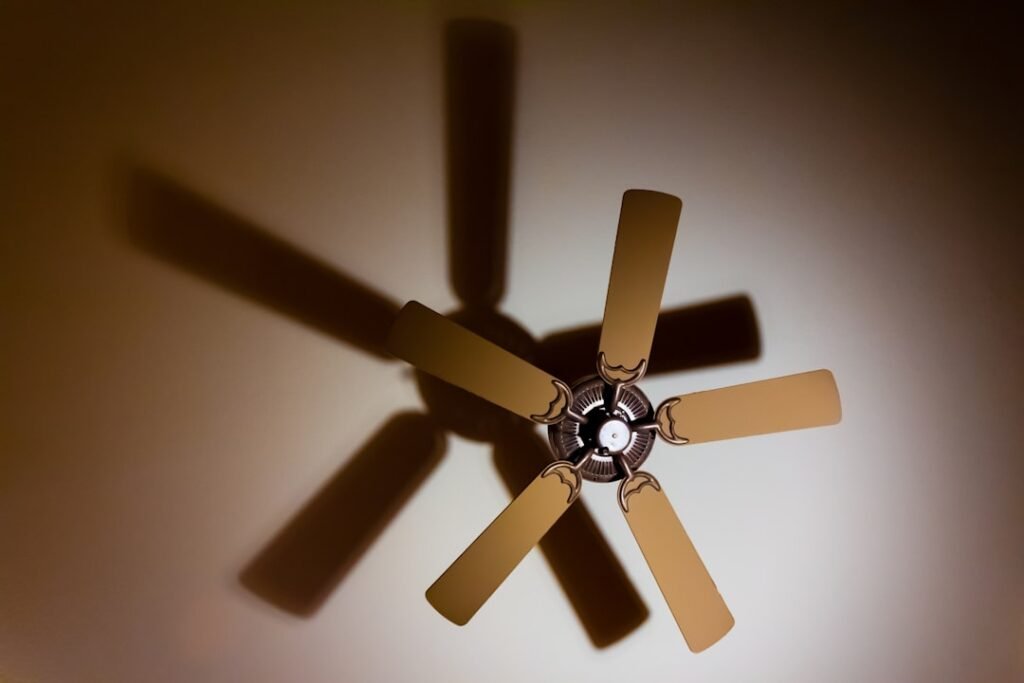
It was a humid Saturday morning in late June — the kind of sticky Connecticut morning where the air just sits on you — and my 12-year-old was already complaining about the heat in his bedroom before 8 a.m. We’d been limping along with a box fan wedged in the window, but I’d finally had enough. I told him we were going to fix the problem the right way, together, and that by lunchtime he’d have a ceiling fan spinning above his head.
He looked at me like I’d just offered to build a rocket ship before noon.
But that’s exactly what we did. And honestly, installing a ceiling fan is one of those home projects that sounds intimidating until you actually do it. With the right preparation, the right tools, and a healthy respect for electrical safety, most homeowners can pull this off in a couple of hours. I’m going to walk you through the whole process — the way I walked my son through it — step by step.
Why Ceiling Fans Are Worth Every Penny in Connecticut
Connecticut summers are no joke. The humidity alone makes 80 degrees feel like 95, and running central air all day gets expensive fast. A ceiling fan doesn’t cool the air the way an AC unit does, but it creates a wind-chill effect that makes a room feel 4 to 8 degrees cooler — which means you can raise your thermostat a few degrees and still be comfortable. That’s real money back in your pocket every month from June through September.
And here’s the bonus: in winter, you reverse the fan direction to push warm air down from the ceiling, which helps your heating system work more efficiently. I already covered how to set a smart heating schedule to cut costs in this guide on reprogramming your thermostat, and a ceiling fan running on low in reverse is the perfect complement to that strategy.
According to the ENERGY STAR program, certified ceiling fans are about 60% more efficient than conventional fans, and when used with air conditioning, they allow you to raise the thermostat about 4°F with no reduction in comfort. For a family of six running multiple rooms, that adds up quickly.
What You’ll Need Before You Start
Gather everything before you climb that ladder. There’s nothing worse than being halfway through a job and realizing you’re missing a part. Here’s what you’ll need:
- The ceiling fan kit (make sure it includes all mounting hardware — most do)
- A flathead and Phillips screwdriver
- Wire strippers
- Needle-nose pliers
- A voltage tester (non-contact — this is non-negotiable for safety)
- A sturdy step ladder
- Electrical tape
- Wire nuts (usually included with the fan)
- A ceiling fan-rated electrical box (if you don’t already have one — more on this below)
My 15-year-old helped me gather tools and read through the fan’s instruction manual before we started. That’s a habit I try to build in all my boys — before you touch anything, understand what you’re about to do. Proverbs says a wise man thinks before he acts, and that applies just as much to home repair as anything else in life.
Step One — Turn Off the Power and Confirm It’s Off
I cannot stress this enough: go to your breaker box and cut the power to the room before you touch a single wire. Don’t just flip the wall switch. Switches only interrupt one leg of the circuit, and depending on how your home is wired — especially in older Connecticut homes — that might not be enough protection.
Once you’ve killed the breaker, use your non-contact voltage tester at the existing light fixture or electrical box before you touch anything. Hold it near the wires. If it beeps or lights up, the power is still on somewhere. Don’t proceed until that tester stays silent.
If you’ve never worked with your home’s electrical system before, this process feels similar to what I described in my guide on how to replace a light switch safely. The fundamental safety rules are exactly the same: confirm power is off, test before you touch, and never rush.
Step Two — Check Your Electrical Box
This is the step most beginner DIYers skip, and it’s the one that causes problems. A standard electrical box rated for a light fixture cannot support a ceiling fan. Fans are heavy and they vibrate during operation, and a regular box will eventually loosen, crack, or fail — potentially bringing your fan crashing down.
You need a ceiling fan-rated box, which is typically labeled as such and rated to support 35 to 70 pounds of dynamic load. If you’re replacing an existing light fixture, check the box first. If it’s a thin plastic box stapled to a joist, replace it. You can buy a ceiling fan-rated brace kit at any hardware store for around $15 to $20, and it installs through the existing hole in the ceiling without needing attic access — perfect for most Connecticut homes where the attic isn’t always easily accessible.
Older homes here in Connecticut — and we’ve got plenty of them — sometimes have knob-and-tube wiring or two-wire systems without a ground. If you open up that ceiling box and you’re not sure what you’re looking at, stop and call a licensed electrician. This is one of those cases where knowing when to call a professional is just as important as knowing how to do it yourself.
Step Three — Mount the Bracket and Hang the Motor
With the right box in place, attach the mounting bracket that came with your fan. Every fan is a little different here, so follow the specific instructions that came in the box — but in general, you’re threading the mounting bracket onto the electrical box and tightening it down securely.
Most modern ceiling fans use a ball-and-socket or hook mounting system that lets you hang the motor housing temporarily while you connect the wires. This is a huge help when you’re working alone or with a curious 10-year-old holding the flashlight and asking seventeen questions. Hang the motor on the bracket hook so it’s supported, then focus on the wiring.
Step Four — Make the Wire Connections
Here’s where people get nervous, but it’s actually straightforward if you follow the color codes. In most installations you’ll be connecting:
- Black wire to black wire (hot — powers the fan motor)
- White wire to white wire (neutral)
- Green or bare copper wire to green or bare copper wire (ground)
- Blue wire to black wire (if your fan has a separate light kit and you have two switches — otherwise cap the blue with a wire nut or connect it to the black)
Twist matching wires together clockwise with needle-nose pliers, then secure them with a wire nut — turning it clockwise until it’s snug. Give each connection a gentle tug to confirm it won’t pull loose. Then wrap the base of the wire nut with a small strip of electrical tape for extra security. My 12-year-old handled the taping while I held the wires — he took real pride in doing something that mattered for the finished product.
Tuck all the wires up carefully into the electrical box, then secure the canopy cover over the mounting bracket according to your fan’s instructions.
Step Five — Attach the Fan Blades
This is the most straightforward part of the whole job and the one the younger boys can actually help with. Fan blades attach to blade brackets (sometimes called blade irons or blade arms), which then screw into the motor housing.
Tighten each screw firmly but don’t overtighten — you don’t want to crack the plastic housing. Make sure every blade is at the same angle and tightened to the same degree. Uneven blades cause wobbling, which causes noise, which causes a very unhappy 12-year-old at 11 p.m. when he’s trying to sleep.
If your fan includes a light kit, attach it according to the instructions and connect the bulbs. LED bulbs are always the right call here — they run cooler and use a fraction of the energy.
Step Six — Restore Power and Test
Before you flip that breaker back on, do a visual check. Are all the wire nuts secure and tucked into the box? Is the canopy cover tight? Are all the blade screws snug? Is there anything hanging loose or touching a moving part?
Once you’re satisfied, restore power at the breaker and test the fan on all speeds. Stand back and watch for wobbling. A little wobble is normal at first — most fan kits include a balancing clip and small weights to correct it. Run the fan, observe, and balance as needed.
Also test the direction switch. Counter-clockwise rotation creates the downdraft cooling effect for summer. Clockwise on low speed pushes warm air down in winter. Mark that switch if you need to — I put a small piece of tape on the winter direction so I remember every November without having to think about it.
When to Call a Professional Instead
I’m always honest about this: some situations call for a licensed electrician, full stop. Call a pro if:
- You open the ceiling box and find aluminum wiring (it’s a silver color, not copper)
- You find knob-and-tube wiring and aren’t comfortable working around it
- There is no ground wire and you’re not sure how to handle it safely
- The circuit is already overloaded and keeps tripping breakers
- You’re installing a fan where there’s no existing wiring — that requires running a new circuit
There’s no shame in knowing your limits. I’ve said this to my boys more than once: wisdom isn’t just knowing how to do something — it’s knowing when to ask for help.
What This Project Taught My Boys
By the time we turned that fan on for the first time, my 12-year-old was genuinely beaming. He’d helped strip a wire, attach blades, and troubleshoot a small wobble. My 10-year-old had handed tools up the ladder and learned why electrical safety matters. Even my 6-year-old, who mostly supervised from a safe distance and asked if the fan could go fast enough to fly, understood that when something in our home needs fixing, we figure it out together.
That’s worth more to me than the $200 I saved not hiring someone. These projects are how I teach my sons that hard work, patience, and a willingness to learn are more powerful than any set of skills you can buy. That’s a lesson I want woven into who they become.
If this is your first time working with home electrical, take it slow, use your voltage tester every single time, and don’t rush. You’ve got this. And on the first hot July afternoon when that fan is humming above you and the room feels ten degrees cooler, you’ll be glad you spent a Saturday morning doing it right.
For more weekend projects that keep your home running well and your utility bills in check, check out how I safely reset a tripped GFCI outlet — another electrical job any careful homeowner can handle themselves.
