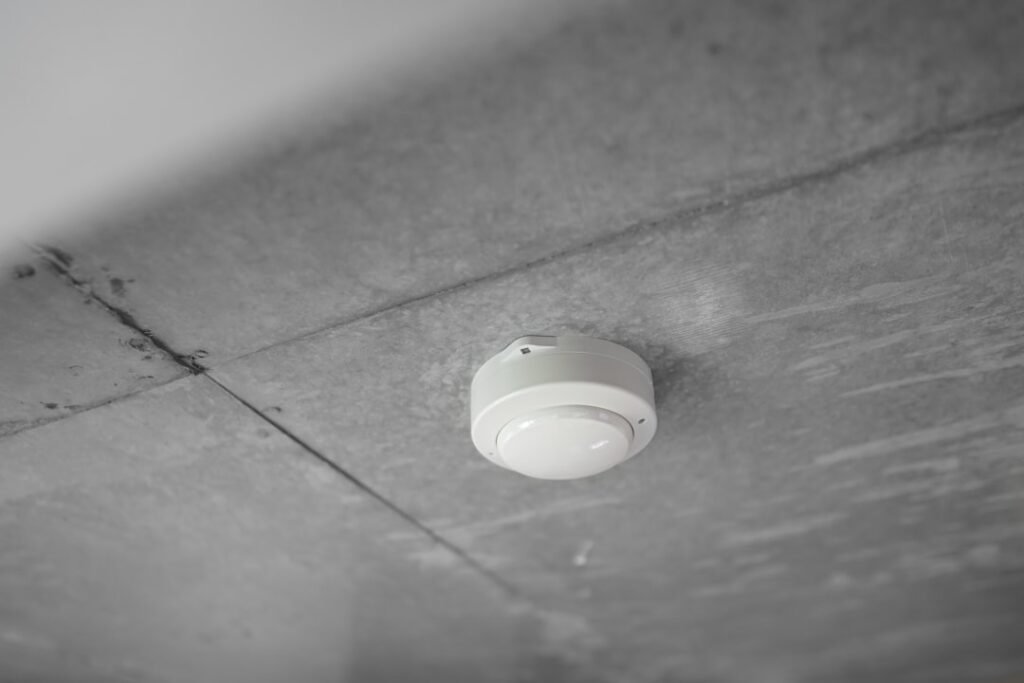
A few weeks ago, my 10-year-old came running into the kitchen with a look of mild panic on his face. “Dad, that thing is beeping again.” He was talking about the smoke detector in the upstairs hallway — the one that chirps every 45 seconds when the battery is getting low. I already knew what I was going to find when I climbed up there: a detector that was well past its useful life, yellow from age, and probably overdue for a full replacement, not just a battery swap.
Here’s something a lot of homeowners don’t realize: smoke detectors have an expiration date. Most manufacturers — and the National Fire Protection Association — recommend replacing smoke alarms every 10 years. The sensing technology inside them degrades over time. A 12-year-old smoke detector in your hallway might look fine, but it may not actually alert your family in time when it matters most. That’s not a risk I’m willing to take.
Replacing a smoke detector is one of the easiest, most important home repairs you can do yourself. No special tools, no permits, no electrician required in most cases. And it’s one of those Saturday-morning projects where even your youngest kid can stand on the floor and hand you parts while learning why fire safety matters. We knocked out every detector in our house in under two hours, and I want to walk you through exactly how to do it.
Why This Matters More Than You Think
Connecticut winters mean closed windows, running furnaces, and homes sealed tight against the cold. That’s exactly the environment where carbon monoxide and smoke can build up fast. According to the U.S. Fire Administration, roughly three out of five home fire deaths happen in homes with no working smoke alarms — either they were missing, dead, or too old to function properly.
Many Connecticut homes, especially the older colonials and Capes that are common throughout the state, have hardwired smoke detectors that were installed when the house was built. If yours were installed in 2012 or earlier, they’re due. And if you’re not sure when they were installed, check the date stamped on the back of the unit — every detector has one.
This is also a great opportunity to upgrade to a combination smoke and carbon monoxide detector, which is something I strongly recommend for any home with a gas furnace, gas range, or attached garage. One device covers two threats, and that simplicity is worth something.
What You’ll Need Before You Start
For most homes, this is a very short shopping list. Here’s what to have on hand:
- New smoke detector(s) — match the type to what you currently have (battery-only or hardwired with battery backup). For hardwired units, buy the same brand if possible so the mounting bracket is compatible.
- Fresh 9-volt or AA batteries — depending on your detector model
- A flathead and Phillips screwdriver
- A stepladder
- A pencil and a drywall anchor kit — if you’re mounting to a new location
- A voltage tester — if you’re working with hardwired units
If you need to build out your toolkit more broadly, I’ve got a full guide on the essential tools every homeowner needs that’s worth bookmarking.
Step 1 — Find Every Detector in Your Home and Check the Dates
Before you buy anything, do a full walkthrough. Write down every smoke detector location and pull each one off the ceiling or wall long enough to read the manufacture date stamped on the back. Most have it printed clearly — something like “Manufactured: March 2011.” If it’s 10 years old or more, it’s getting replaced today regardless of whether it seems to be working.
Connecticut building code generally requires smoke detectors on every level of the home, inside each bedroom, and outside each sleeping area. If you’re missing coverage in any of those spots, now is the time to add it. The Connecticut Office of State Building Inspector publishes current residential code requirements if you want to verify your home’s specific setup.
I made a simple list on a notepad: location, manufacture date, type (battery or hardwired), and whether it needed replacing. My 12-year-old helped me with this part and actually thought it was interesting that the detectors had dates on them — it turned into a quick conversation about why things wear out and why maintenance matters. Those are the moments I live for on a Saturday morning.
Step 2 — Turn Off Power to Hardwired Detectors
If your detectors are hardwired — meaning they have a wire harness that plugs into the ceiling — you’ll need to shut off the circuit that feeds them before you disconnect anything. Head to your breaker panel and locate the circuit labeled for smoke detectors or hallway lights (they’re sometimes on the same circuit). Flip it off and use a non-contact voltage tester to confirm the power is dead before you touch any wires.
Battery-only detectors skip this step entirely. Just twist them off and you’re done with the electrical portion.
If you’re not comfortable around your breaker panel or wiring, this is a good moment to pause and either read up on basic electrical safety or call a licensed electrician. There’s no shame in knowing your limits. That said, the wiring involved in smoke detector replacement is about as simple as residential electrical gets — we’re talking about a three-wire plug-in connector, not complex wiring.
Step 3 — Remove the Old Detector and Mounting Bracket
Most smoke detectors remove with a simple quarter-turn twist. Turn the unit counterclockwise and it should pop free from its mounting bracket. For hardwired units, once the detector is loose, you’ll see the wire harness connector — press the tab and unplug it. Set the old unit aside.
Now look at the mounting bracket. If you bought the same brand and model line, the new detector will likely use the same bracket, which saves you a step. If you’re switching brands or upgrading to a combo unit, you’ll need to unscrew the old bracket and mount the new one.
To remove the old bracket, back out the two or three screws holding it to the ceiling box or drywall. If the new bracket uses different hole spacing, you may need to use the new screws and anchors that came in the box. Mark the holes with a pencil, drill pilot holes if needed, and get the new bracket snug against the ceiling. Don’t overtighten into drywall — you’ll strip it. Snug is enough.
Step 4 — Connect and Install the New Detector
For battery-only units, this is simple: install your fresh batteries, mount the detector onto the bracket with a clockwise twist, and you’re done.
For hardwired units, take the wire harness connector from your new detector and plug it into the ceiling wires. Most connectors are keyed so they only go in one way — don’t force it. Once it clicks in, tuck the excess wire neatly into the ceiling box, seat the detector onto the bracket, and give it a clockwise twist to lock it in place.
Now go back to the breaker panel and restore power. The detector should chirp once or flash a light to confirm it has power. Install the backup battery (most hardwired units still have a battery slot for power outages), and you’re in business.
Step 5 — Test Every Detector You Installed
This is the step you absolutely cannot skip. Every single detector needs to be tested after installation. Press and hold the test button until you hear the alarm sound — it should be loud and clear. If a unit doesn’t respond, check the battery connection and make sure the harness is fully seated.
If you installed interconnected hardwired detectors (meaning when one goes off, they all go off), trigger one and confirm the rest follow. This is a code requirement in Connecticut and a genuinely life-saving feature in a multi-story home.
I let my 6-year-old press the test button on the one in the hallway. He covered his ears and grinned. My 15-year-old rolled his eyes a little — but he also now knows every detector in this house works. That’s the point.
Hardwired vs. Battery-Only: What’s Right for Your Home?
If your home currently has hardwired detectors, replace them with hardwired units. Don’t downgrade to battery-only just because it seems easier. Hardwired units with battery backup give you the best of both worlds — they stay on even during a power outage and they don’t rely solely on you remembering to swap batteries once a year.
If your home has only battery-operated detectors and you’re doing a renovation, it’s worth talking to a licensed electrician about upgrading to hardwired. It’s not a massive job if you’re already opening up walls or ceilings for another reason.
For combination smoke and carbon monoxide detectors, I recommend them for any home with a gas appliance, oil boiler, or attached garage. One well-placed combo unit near sleeping areas covers both threats. This pairs well with the work we did when we winterized our plumbing and got the house ready for a Connecticut cold season — it’s all part of the same mindset of getting ahead of problems before they become emergencies.
Placement Tips That Most People Get Wrong
Where you put a smoke detector matters as much as which one you buy. Here are a few things to keep in mind:
- Keep detectors at least 10 feet from cooking appliances to reduce nuisance alarms from normal cooking. If that’s not possible, look for a detector with a “hush” button or a model rated for kitchen proximity.
- Don’t install smoke detectors near windows or vents where drafts can interfere with the sensing chamber.
- Ceiling placement is preferred, but if you’re mounting to a wall, stay within 4 to 12 inches of the ceiling — smoke rises and accumulates there first.
- Avoid unheated attics or garages — extreme temperature swings cause false alarms and degrade sensors faster.
- In bedrooms, install on the ceiling near the door, not directly over the bed, so the alarm is between the sleeping area and the exit.
What This Project Costs — and What It’s Worth
A basic smoke-only detector runs $10 to $20. A combination smoke and CO detector from a reputable brand like Kidde or First Alert runs $25 to $45. Replacing every detector in an average Connecticut home — say, six to eight units — will run you somewhere between $80 and $250 depending on what you choose. That includes batteries.
Compare that to a service call where someone comes out to do the same job and you’re likely looking at $200 to $400 in labor alone, depending on the company and how many units need replacing. This is genuinely one of the best dollar-per-hour DIY returns you’ll find on any home project.
And unlike a leaky basement or a broken stair tread, this isn’t just about property value or convenience. This is directly about whether your family has time to get out of the house if something goes wrong at 2 AM. That changes the math completely.
Make It a Habit, Not a One-Time Fix
Once you’ve replaced everything, put a reminder in your calendar: test every detector on the first Sunday of every month. It takes two minutes and it keeps you confident that your system actually works. Replace batteries every year — we do it when we change the clocks in the fall. And write the installation date on a piece of masking tape and stick it to the back of each new detector so your future self knows exactly when it’s time to replace them again.
There’s a verse I come back to often when it comes to taking care of what God’s given us: “A prudent man sees danger and takes refuge.” Replacing a smoke detector isn’t dramatic. It’s not a big weekend project. But it’s one of those quiet, responsible acts of stewardship that says: I’m paying attention, and I’m not going to let complacency put my family at risk.
Get up there, pull those old units down, and get new ones in. Your family is worth two hours on a Saturday morning.

Pingback: How to Replace a Carbon Monoxide Detector Yourself — A Connecticut Dad’s Complete Guide to Protecting Your Family from an Invisible Threat - cthomerepairandtutoring.com