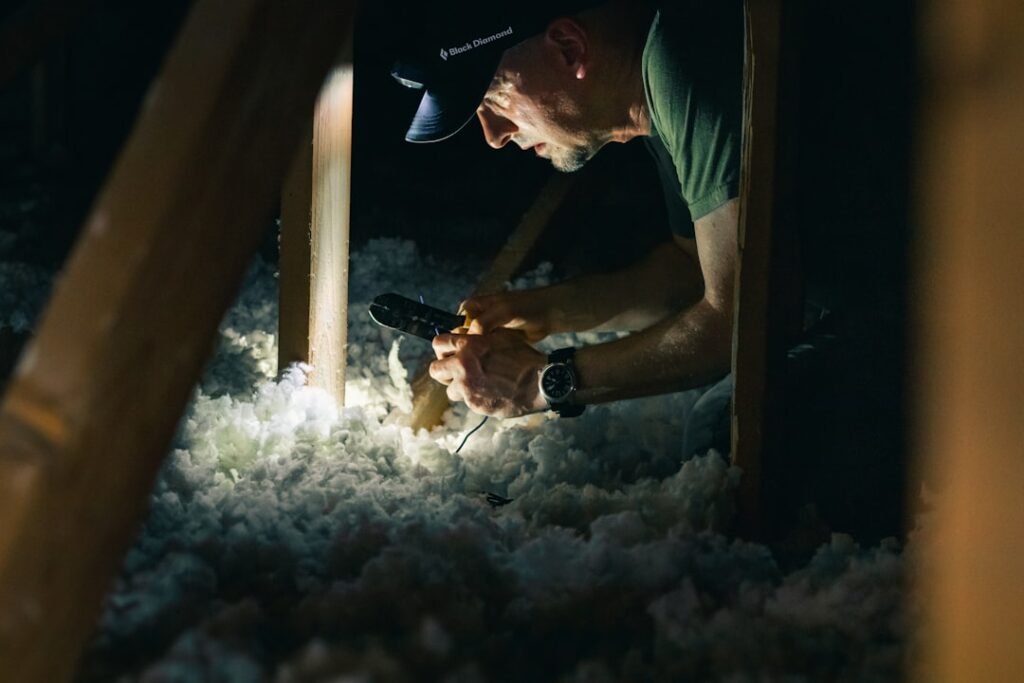
Last February, during one of those brutal Connecticut cold snaps where the temperature doesn’t crack 15 degrees for a week straight, I went up into our attic to grab some holiday storage bins. I wasn’t up there for more than five minutes, but what I found — or rather, what I felt — stopped me in my tracks. The attic floor was barely insulated. Cold air was pouring in around every eave, and I could practically see daylight through a couple of gaps near the roofline. No wonder our heating bills had been quietly creeping up every winter. We were essentially paying to heat the outdoors.
That Saturday, I pulled my 15-year-old and my 12-year-old into the project. We spent a morning up there together, sweating through our layers despite the cold, adding blown-in insulation over the existing batts. By the end of the day, we’d transformed one of the most overlooked spaces in our house into a proper thermal barrier — and trimmed nearly $180 off our heating bill that winter compared to the year before. Not bad for a weekend project and about $400 in materials.
If you’re a Connecticut homeowner and you haven’t checked your attic insulation recently, this guide is for you. This is one of the highest-return DIY projects you can tackle — high impact, manageable cost, and genuinely doable in a weekend with the right preparation.
Why Attic Insulation Matters More Than Almost Anything Else in a Connecticut Home
Heat rises. That’s not just a physics lesson — it’s a financial reality for every homeowner in New England. According to the U.S. Department of Energy’s ENERGY STAR program, heating and cooling account for roughly half of a home’s total energy costs, and a poorly insulated attic is often the single biggest source of heat loss in older homes. Connecticut’s housing stock skews older — a lot of us are living in homes built in the 1960s, 70s, and 80s — and those homes were often insulated to standards that simply don’t hold up to modern winters or modern energy costs.
The building code in Connecticut now calls for attic insulation at R-49 to R-60 in most climate zones. Many older homes are sitting at R-11 or R-19, which is less than half of what’s recommended. That gap is money leaving your house through the ceiling every single day from November through March.
Beyond heating bills, proper attic insulation helps with:
- Preventing ice dams along your roofline (a very real problem in CT winters)
- Reducing humidity infiltration that can cause mold and structural damage
- Keeping your home cooler in July and August without overworking your AC
- Extending the life of your HVAC system by reducing its overall workload
If you’ve already worked through some of our other winterization projects — like winterizing your pipes or reprogramming your thermostat for a smarter heating schedule — adding attic insulation is the logical next step. Those fixes help. This one changes the game.
Types of Attic Insulation: What You’re Working With
Before you buy anything, you need to understand your options. There are three main types of insulation used in residential attics:
- Fiberglass batts — The pink or yellow rolls you’ve probably seen at Home Depot. These are pre-cut and relatively easy to lay between joists. Good for attics with easy access and no existing insulation. R-value per inch is around 3.1 to 3.4.
- Blown-in fiberglass or cellulose — Loose-fill insulation that gets blown into place using a rented machine. Excellent for covering existing insulation, filling irregular spaces, and getting into tight corners. Cellulose is made from recycled paper and is a great eco-friendly choice. This is what we used, and it’s my recommendation for most CT attics.
- Spray foam — The gold standard for air sealing, but expensive and best left to professionals for large applications. You can use canned spray foam for sealing gaps around penetrations, which we’ll cover below.
For most Connecticut homeowners doing this themselves, I recommend a combination approach: seal all air gaps first with canned spray foam, then add blown-in cellulose on top of whatever existing insulation you have. That one-two punch addresses both air infiltration and thermal resistance — and it’s what actually moves the needle on your energy bills.
What You’ll Need Before You Start
Gather everything before you go up. Trips down the attic ladder mid-project get old fast, especially when you’re wearing a respirator and goggles.
- Safety equipment: N95 respirator or better, safety goggles, disposable coveralls or old clothes you don’t mind ruining, work gloves, knee pads
- Flashlight or headlamp — a headlamp is far better, keeping your hands free
- Attic insulation blower — rentable for free or cheap at most big-box hardware stores when you buy a minimum number of bags of cellulose (usually 10 bags)
- Blown-in cellulose insulation — calculate your square footage and desired R-value; bags will tell you coverage per bag at different depths
- Canned expanding spray foam — for sealing gaps around pipes, wires, and junction boxes before you insulate
- Attic baffles (rafter vents) — foam or cardboard channels that keep insulation from blocking soffit vents; critical for proper attic ventilation
- Rigid foam board scraps or cardboard — to create a dam around the attic hatch so insulation doesn’t spill in
- Tape measure and marker — for depth measurement stakes
- Wood scraps or furring strips — to create walking boards so you don’t step through the ceiling
Step 1: Check What You Already Have
Before you add anything, take stock of what’s already there. Bring a tape measure and check the existing insulation depth in several spots across your attic floor. If you’re seeing 3 to 4 inches of old fiberglass batts, you’re probably sitting around R-11 to R-13. If you see 6 to 7 inches of older blown-in, you might be at R-19. Connecticut’s climate zone calls for R-49 minimum — so in most cases, you’ve got a lot of room to improve.
Also look for signs of moisture damage in the existing insulation. Wet, compressed, or discolored insulation has lost much of its R-value and may need to be removed before adding new material. If you spot significant mold, stop and consult a professional — don’t blow new insulation over a moisture problem. You’ll also want to check that your attic has adequate ventilation before adding insulation. Blocked soffit or ridge vents combined with new insulation can trap moisture and cause serious structural damage over time.
Step 2: Seal Every Air Bypass First — This Step Is Non-Negotiable
This is the part most homeowners skip, and it’s the reason their results disappoint them. Insulation slows heat transfer. Air sealing stops it. If you have gaps around recessed lights, plumbing stacks, electrical wires, and framing penetrations, warm air from your living space is bypassing the insulation entirely and pouring straight into your attic.
Before you add a single bag of blown-in, go around the entire attic floor with your canned spray foam and seal every penetration you can find. Common culprits include:
- Gaps around plumbing vent stacks and pipes
- Holes where electrical wires pass through top plates
- Around recessed light fixtures (use a fireproof cover box over these first)
- Around the attic hatch frame
- Gaps where interior walls meet the attic floor framing
My 15-year-old handled most of the spray foam work while I marked the spots with a flashlight. He learned more about how heat moves through a house in that one morning than any textbook could have taught him. These are the kinds of lessons that stick.
Step 3: Install Attic Baffles at Every Rafter Bay
Before you blow in any insulation near the eaves, install foam or cardboard baffles (also called rafter vents) in each rafter bay along the perimeter of your attic. These channel staple directly to the roof sheathing and create a clear airway from your soffit vents up to the ridge. Without them, blown-in insulation will clog your soffits, block the airflow your attic needs, and create moisture problems that can rot your roof deck.
This step is especially important in Connecticut, where ice dams are a real seasonal threat. A properly ventilated attic stays cold enough that snow doesn’t melt unevenly on your roof and refreeze at the eaves. Baffles are the unsung heroes of a healthy attic system. Don’t skip them.
Step 4: Set Your Depth Stakes
Before you start blowing insulation, make small depth indicator stakes out of wire or paint stir sticks and mark them at your target depth. For R-49 with cellulose, you’re typically looking at around 12 to 14 inches total depth. Space your stakes every 4 to 6 feet across the attic floor so you can see at a glance whether you’re hitting the right depth as you work.
Step 5: Blow In the Insulation
Load the blower machine according to the rental instructions, feed the hose up into the attic, and start at the far end — working backward toward the attic hatch so you don’t walk over your fresh insulation. Keep the hose end about 12 inches off the floor of the existing insulation as you work, and use a slow, sweeping motion to build up even coverage.
Work in sections, checking your depth stakes regularly. Pay extra attention to corners and the areas along the eaves — these spots tend to get thin coverage. Keep the insulation clear of the baffles you installed at the rafter bays.
When you get close to the attic hatch, build a small dam out of rigid foam board or cardboard along the hatch frame before you finish. This keeps insulation from falling into the house when you open the hatch, and it also allows you to insulate the hatch door itself — which is often a major heat loss point on its own. Glue rigid foam board directly to the top of the attic hatch cover and you’ve addressed that problem in about ten minutes.
Step 6: Clean Up and Do a Final Walkthrough
Once you’ve reached your target depth across the entire attic floor, do a careful walkthrough (on your walking boards — don’t step directly on fresh insulation or you’ll punch through the ceiling below). Check for any thin spots, make sure the baffles are still clear and unobstructed, and confirm the area around the attic hatch is properly sealed and built up.
Return the blower machine, clean up your gear, and take a moment to appreciate what you just accomplished. I genuinely believe there’s a satisfaction in this kind of work that goes beyond the financial return — it’s the quiet knowledge that you’ve protected your family, improved your home with your own hands, and done it alongside your kids. Providence has a way of blessing that kind of faithful stewardship.
What It Actually Costs — And What You’ll Save
For a typical Connecticut home with 1,000 square feet of attic space, you’re looking at roughly $300 to $500 in materials (cellulose bags plus spray foam, baffles, and safety gear) if you’re starting from scratch. The blower machine is usually free with a minimum cellulose purchase. A professional installation of the same scope would run $1,500 to $3,000 or more depending on the contractor.
The ENERGY STAR program estimates that proper attic insulation and air sealing can reduce heating and cooling costs by 15% or more annually. In Connecticut, where natural gas and heating oil bills can hit $300 to $400 per month in peak winter, that’s a meaningful number — and the project typically pays for itself in two to three heating seasons.
If you’ve already worked through projects like sealing drafty doors and caulking bathroom gaps, adding attic insulation is the next logical layer of a whole-home efficiency strategy. Each project builds on the last.
When to Call a Professional Instead
This is a very DIY-friendly project, but there are situations where you should bring in a pro:
- You find active moisture damage, mold, or signs of a roof leak
- Your attic has knob-and-tube wiring (common in older CT homes) — this requires an electrician’s evaluation before you add insulation over it
- You have recessed lights that are not rated for insulation contact (IC-rated) — these need fireproof covers installed before you insulate over them
- The attic is inaccessible or structurally compromised
Knowing your limits isn’t weakness — it’s wisdom. The same rule I teach my boys applies here: understand the task fully, do what you’re equipped to do well, and call someone better suited when the situation calls for it.
This winter, your attic doesn’t have to be a liability. With a weekend, the right materials, and a willingness to get a little dusty, you can turn it into one of the best investments your home ever saw. And if your kids are old enough to help — bring them up there. There’s no better classroom than one where the lesson actually matters.
